What humanoid robots
can achieve today
Real-world use cases demonstrating what humanoid robots are technically capable of implementing with their current skill sets: tested and proven in industrial pilot projects and test facilities.
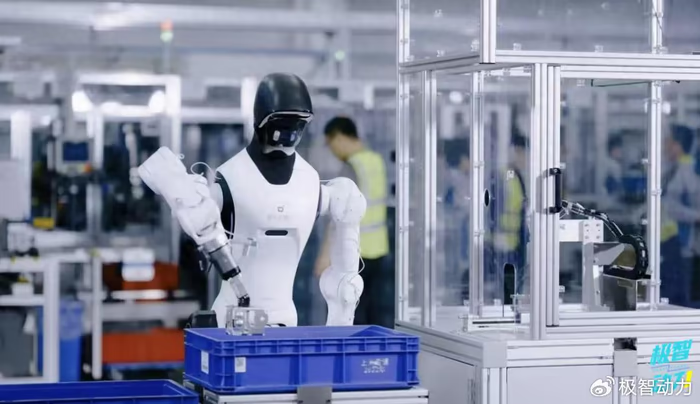
Pick & Place
Precision grasping, positioning, and placement: dependable in multi-shift operations.
Humanoid robots handle loading and unloading of machinery, parts sorting, and bin packing completely autonomously. AI vision reliably identifies components even when presented chaotically or unstructured.
- Autonomous loading & unloading of CNC machines, presses, and test benches
- Reliable recognition of unstructured parts via 3D AI vision
- Seamless integration without modifying existing factory lines
- 24/7 continuous operation across multiple shifts without manual intervention
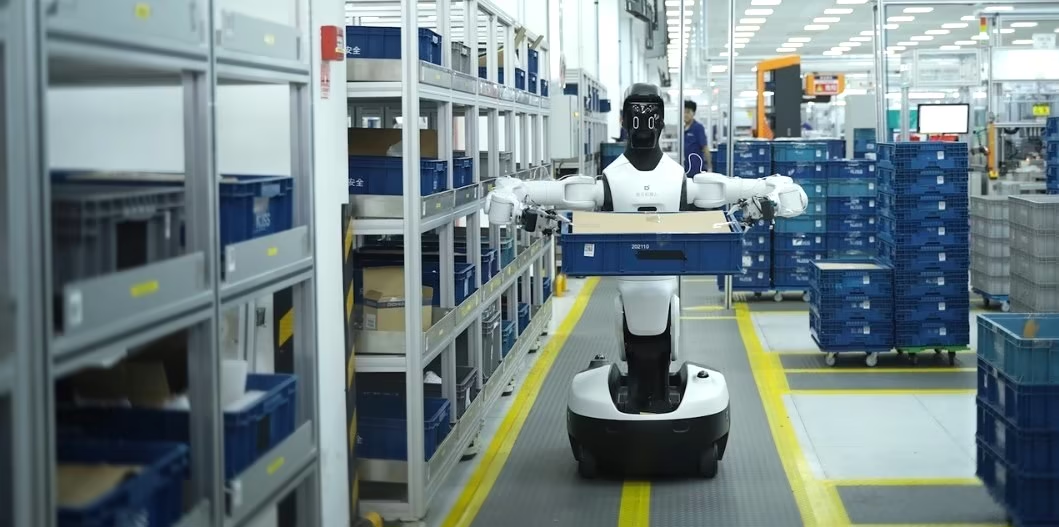
Material Handling
Autonomous parts transport and kitting between work cells: no floor markings, no rebuilding.
Humanoid robots handle internal transport of components, totes, and materials autonomously. They navigate safely through existing facilities, avoid dynamic obstacles, and transfer parts directly to workstations.
- Dynamic navigation without floor markers or magnetic guidance tracks
- Secure grasping and tote manipulation powered by 3D AI vision
- Reliable container stacking and pallet organization
- Safe obstacle avoidance in shared human-robot environments
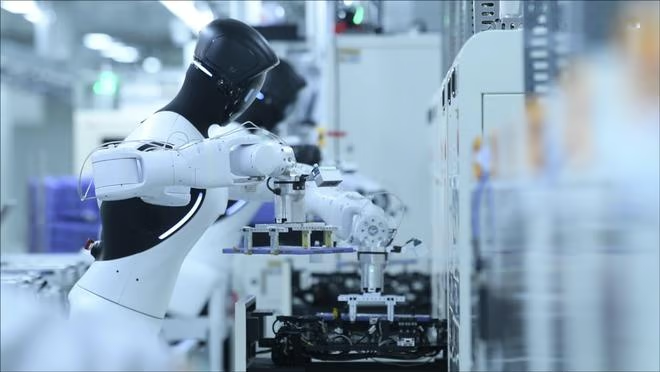
Quality Inspection
Seamless visual inspection with complete digital documentation in real time.
Equipped with high-resolution RGB-D sensors and trainable AI image processing, humanoid robots detect defects with higher repeatability than manual visual inspection, logging complete audit trails for traceability.
- Real-time detection of surface defects, misalignments, and dimensional deviations
- Automated logging for end-to-end quality audit trails and traceability
- Trainable AI: easily updated for new part geometries and variants
- Deployable at existing inspection stations and measurement fixtures without line rebuilds
Humanoid Robots in Industrial Practice: Where Deployment is Realistic Today
The discussion surrounding humanoid robots in manufacturing has shifted fundamentally. The question is no longer whether the technology will arrive on the shop floor, but which concrete tasks it can already execute reliably under real-world operating conditions. Industry data indicates a clear pattern: the primary areas of deployment today are manufacturing, intralogistics, and warehousing, as well as material handling and repetitive assembly support.
The reason for this focus is practical. Factory floors, warehouses, and logistics hubs were built for humans: stairs, doors, tools, and machines are configured for human anatomy. A humanoid robot navigates this existing infrastructure without requiring expensive redesigns. This is the decisive difference compared to traditional automation: whereas a stationary robotic cell forces the environment to adapt to it, a humanoid robot adapts to the existing environment.
Why Pilot Projects are the Strategic Starting Point
Humanoid robotics is currently in a phase of rapid transition. Moving from pilot deployments to full-scale operations is a phased process, which represents a strategic advantage. Major manufacturers follow this exact roadmap: BMW Group is conducting a pilot project at its Leipzig plant, marking the first deployment of humanoid robots in automotive production in Germany. The robot performs repetitive handling tasks, delivers components to the line, and navigates obstacles with precision.
For your enterprise, this means: A sensible start does not begin with an all-in investment, but with a clearly scoped use case. Manufacturers should first analyze which processes can be realistically automated and which still require human expertise due to micro-tolerances. Based on this analysis, pilot projects with clearly defined KPIs are selected.
This approach reflects a fundamental characteristic of the technology: A humanoid robot is not an off-the-shelf solution at the time of purchase, but an advanced hardware platform. Only training on your specific process transforms it into a productive application. That is precisely what our pilot project achieves. We engineer the robot application for your process and train vision-based AI models, with data capture, training, and validation hosted on European servers or directly in your IT environment. Proving that the robot executes the task autonomously is validated in a multi-week trial phase. Only this proof of concept forms the basis for discussing fleet rollout.
Transparent Boundaries
A dependable integration partner must also state where humanoid robots are currently not the right solution. Specialized industrial robots still significantly outperform humanoid systems in pure cycle time, extreme precision, and cost per cycle for stationary, high-speed repetitive tasks. In such cases, traditional robotic cells remain superior.
The strength of humanoid systems lies elsewhere: in tasks involving changing part geometries, unstructured workspaces, or mobility across multiple work cells, wherever dedicated machinery would never amortize due to process variability. We establish this distinction together with you during our initial feasibility assessment before any capital expenditure is committed.
Characteristics of an Ideal Use Case
In our experience, processes are particularly well-suited for humanoid robots when they meet several key criteria: The task is repetitive but does not require sub-millimeter precision. Parts vary in shape or orientation, exceeding the limits of rigid programming. The workstation is built for humans and rebuilding would be cost-prohibitive. And the role is physically straining or difficult to staff.
We evaluate these criteria systematically and will clearly inform you if a process is not currently suitable for humanoid automation.